Guide
How Long Should a Sub-Zero Wine Cooler Last?
Expect roughly ten years from a freestanding compressor wine cooler, around five from a small thermoelectric model, and fifteen to twenty from a built-in Sub-Zero wine storage unit whose condenser and door seals get regular attention. Those are typical working lives rather than fixed dates: the same cabinet can wear out early in a hot garage or keep going well past the average in a cool, well-ventilated kitchen. In Solana Beach the biggest swing factor is the coastal air, which carries salt and moisture onto the parts that shed heat. Knowing roughly where your unit sits on that curve tells you whether a repair buys years of stable storage for your bottles or only postpones a replacement by a season.
Why the type of cooler sets the ceiling
A thermoelectric cooler moves heat with a solid-state module and a small fan, so it runs quietly but struggles whenever the room warms up, and those parts wear fast from working flat out. A freestanding compressor cooler is a refrigerator in miniature, with a compressor, condenser, evaporator and fan, and it ages much like one. A built-in wine storage unit carries a heavier sealed system, vents from the front so it can sit flush in cabinetry, and is meant to be repaired part by part, which is what lets it reach the top of the range.
- Thermoelectric countertop or under-shelf cooler: often about five years.
- Freestanding compressor cooler: around ten years.
- Built-in compressor wine storage with regular care: fifteen to twenty years.
Working out how old your cooler really is
Plenty of owners inherit a wine unit along with the house, and its age is the first number that matters. The original invoice, the remodel paperwork or a manual tucked into a kitchen drawer usually settles the question. Sub-Zero's own naming helps as well: in March 2019 the Built-In line was renamed Classic and the Integrated line became Designer, so literature that still carries the older names points to a unit made before that switch. The model and serial numbers sit on a serial tag inside the cabinet. Copy both down before you phone anyone, since they let a technician identify the exact unit and order matching parts instead of guessing from a photo of the front panel.
Salt air and the condenser nobody looks at
Solana Beach sits right on the Pacific, and the marine layer that drifts in on so many mornings carries salt and moisture well inside homes, whether the house is a few blocks from the sand or up in Lomas Santa Fe. That damp film settles on condenser fins and grabs dust and lint, and over the years the salt pits the metal until the coil sheds heat less well. A wine cooler fighting a coated coil runs its compressor longer every hour, and runtime is exactly what wears a compressor out. The process speeds up when a unit lives in a garage or on a covered patio, where summer heat piles on top of the salt. None of it shows from the front, which is why a spotless-looking cooler can be aging ahead of schedule behind its grille.
Habits that genuinely add years
Most of the life a cooler gains comes from two cheap habits, both in Sub-Zero's own care instructions. The condenser wants cleaning every six to twelve months, sooner in a household with pets, and the door seals want a gentle wipe before grime hardens on them. To hand the job off, see our preventive maintenance page.
- Brush or vacuum the condenser lightly and keep the aluminum fins straight; Sub-Zero calls chemical coil sprays unnecessary.
- With the power off, wash the gaskets using warm water and a little mild detergent on a soft cloth, or a baking soda paste for stubborn marks.
- Where mildew has spotted a seal, dilute household bleach at a 1:10 ratio with water, and leave the vinegar and rubbing alcohol in the cupboard.
Where the cabinet lives counts as much as the badge
Wine storage is designed for an ordinary living space, not a hot shed. Sub-Zero's checklist for warm alarms on its wine units starts by asking whether the room stays between 60 and 90 degrees Fahrenheit, because outside that band the system either cannot dump heat fast enough or cannot regulate the cabinet properly. On Classic wine storage, EC 10 and EC 12 are the warm alarms for the upper and lower sections, and EC 11 and EC 13 are their cold counterparts. A unit that throws those alarms every summer is not necessarily failing; it may simply be installed somewhere it was never meant to live. Move it, restore the ventilation gap or shade the door from afternoon sun, and you take years of strain off the compressor.
Codes that name a part, and the one that names the heart
Error codes help you judge age because most point at one replaceable part. Classic wine storage uses EC 05 for a bad reading from the upper cabinet sensor and EC 07 for the lower one, with EC 06 and EC 08 doing the same job for the two evaporator sensors; each needs service, but a failed sensor says little about remaining life. A Designer wine unit showing 95 1 00 is merely reporting that someone left the zone 1 door ajar for at least 20 minutes. Code 40 1 09 is a zone 1 cooling fault: cut power at the breaker for 30 seconds, and if it reappears, book a technician. EC 15 is different, since it reports a sealed system fault in the compressor and refrigerant core, the code that turns a repair into a repair-or-replace decision.
Signs that age, not one part, is the trouble
One failure in ten years is ordinary wear; a run of them is what says the machine itself is tiring. First rule out simple causes, such as the display-versus-bottle gap covered on our wine temperature page, then watch for these:
- The compressor seems to run almost nonstop, yet the bottles still sit warmer than the screen claims.
- Different parts have failed one after another over the last year or two.
- Rust has crept across the condenser, the base rail or the cabinet floor.
- The gasket has gone hard all the way around instead of tearing at one corner.
- A buzz, rattle or knock has grown louder month by month rather than appearing overnight.
- Water keeps returning to the floor after the drain and tray have already been cleared.
Repair or replace: what to weigh
Start with the type and the age. A built-in unit at eight or ten years with a sensor, fan or gasket problem is usually worth fixing, because the cabinet has plenty of working life ahead and any replacement has to fit the same opening in your cabinetry. A freestanding cooler of that age with a sealed system fault rarely is. If your Sub-Zero is an outdoor-approved model, check the purchase date first: its outdoor limited warranty covers parts and labor for one year and the sealed system for five. Then weigh the collection itself, since bottles meant to age for years deserve a cabinet that holds steady. For a second opinion on which side of that line your unit falls, our wine cooler repair page is the place to begin.
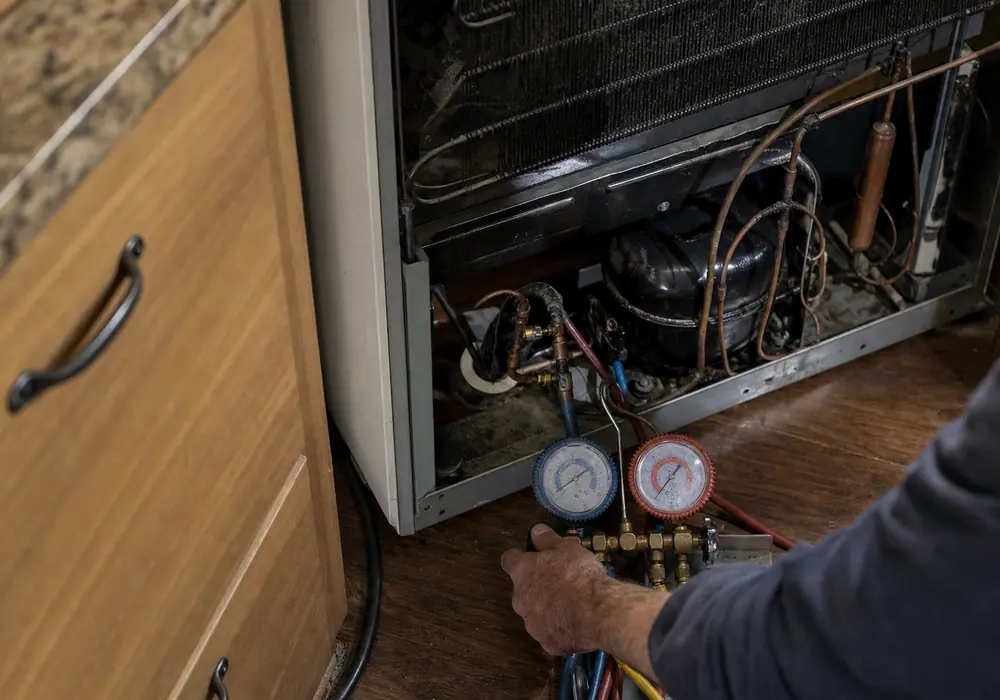
Questions
Answers before you call
Is a ten-year-old wine cooler worth repairing?
Often it is, provided it is a built-in compressor unit and the fault sits in a sensor, fan, gasket or control rather than the sealed system. At ten years a well-kept built-in has usually spent about half its working life, while a freestanding compressor cooler is near the end of its normal run and a thermoelectric one is already past it. A sealed system failure on an aging freestanding cooler is the case where buying new usually wins. That is a two-minute call to Solana Beach Sub-Zero Repair on (858) 703-5919.
Why is my wine cooler not cooling when it still runs?
A clogged condenser is the most common reason a running wine cooler drifts warm. If the coil has gone more than three months without a cleaning, Sub-Zero suggests doing that first and then giving the cabinet a full 24 hours to pull its temperature back. A brand-new unit may also chill only one zone at a time at first, so a warm second zone on day one is not by itself a fault. Solana Beach Sub-Zero Repair, Solana Beach: (858) 703-5919.
Can a worn door gasket shorten a wine cooler's life?
Yes, because a seal that leaks lets warm, damp air in and stretches every compressor cycle. Switch the unit off before cleaning it, and skip vinegar and rubbing alcohol, which do the rubber no favors. A gasket that is ripped, torn or cracked should be replaced, and Sub-Zero suggests leaving that swap to a service technician; its gaskets are sold through the maker's parts distributors, not through online shops. Say so when you call Solana Beach Sub-Zero Repair on (858) 703-5919.
If it is already broken
Appliance down in Solana Beach?
Tell us the brand and what it is doing — we can usually name the likely repair before we arrive.